关键词:春旱; 滴灌; 埋深; 产量; 水分利用效率 Effects of Different Drip-Irrigation Modes at the Seedling Stage on Yield and Water-Use Efficiency of Spring Maize in Northeast China XU Jie1,2, LI Cong-Feng1, MENG Qing-Feng1, GE Jun-Zhu3, WANG Pu2, ZHAO Ming1,* 1Institute of Crop Science, Chinese Academy of Agricultural Sciences, Beijing 100081, China
2College of Agronomy and Biotechnology, China Agricultural University, Beijing 100193, China
3College of Plant Science & Technology of Huazhong Agricultural University, Wuhan 430070, China
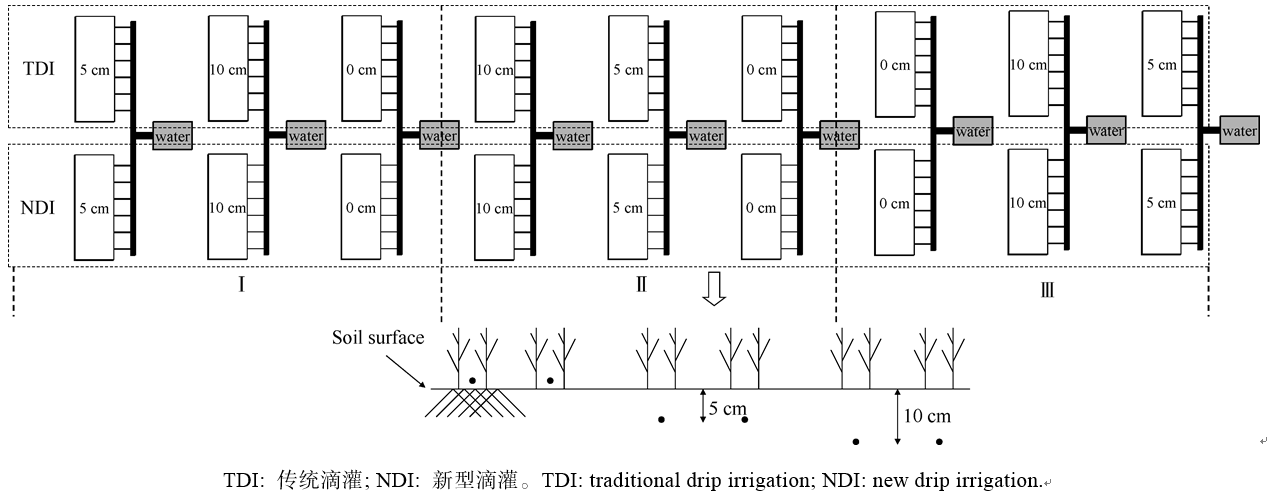
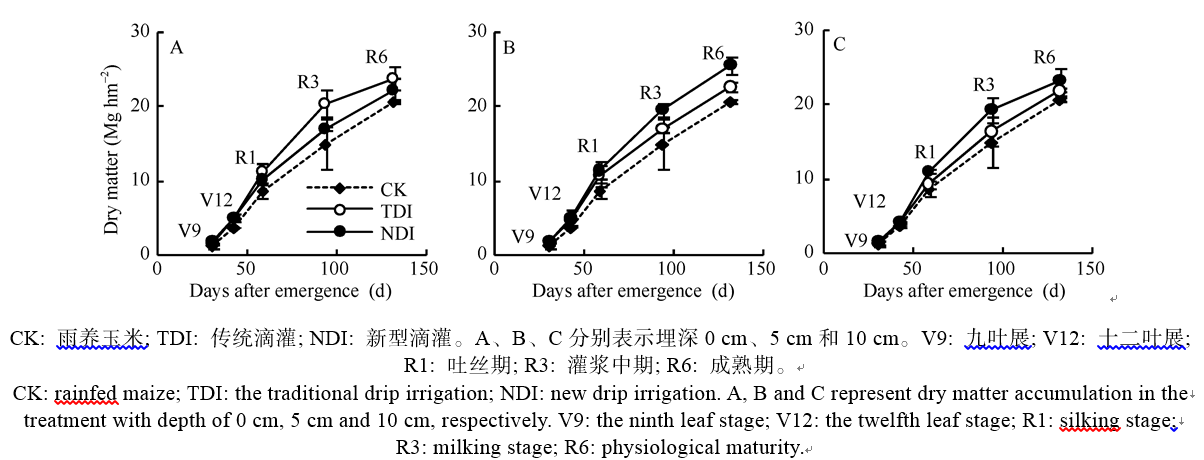
AbstractThe seasonal drought especially in spring is one of the major obstacle factors for yield improvement in maize production in Northeast China. Drip irrigation could effectively alleviate drought while different drip irrigation strategies have different impacts. Using rainfed maize as a control (CK), we compared the effects of traditional drip irrigation (using the embedded labyrinth drip irrigation tube, TDI) and new drip irrigation (using the new drip irrigation tube, NDI) together with three depths of tube (0 cm, 5 cm, and 10 cm) on maize growth, yield, and water use. Compared with CK, irrigation treatments significantly increased grain yield by 9.5%-20.1%. For TDI, no significant yield difference was observed among three tube depths. For NDI, grain yield in treatment with 5 cm tube depth was 4.4% higher than that with 0 cm tube depth. At the same tube depth between TDI and NDI, no significant yield difference was observed with an exception of NDI with 5 cm tube depth, which increased yield by 8.8%. Compared with CK, yield increase with irrigation mainly resulted from the improvement of emergence rate, which was increased by 12%. The ear number per ha was improved by 13%. The higher yield in NDI with 5 cm tube depth was because of the delayed leaf senescence and higher total dry matter accumulation. Compared with CK, irrigation improved water use efficiency by 8.1%-10.9%, with the highest in NDI with 5 cm tube depth. Therefore, using NDI with 5 cm tube depth could be an effective strategy to increase both yield and water use efficiency of spring maize in Northeast China.
Keyword:Spring drought; Drip irrigation; Dripline depth; Yield; Water use efficiency Show Figures Show Figures
表1 玉米生长季气象条件 Table 1 Weather data during maize growth season
月份 Month
平均温度Average temperature (℃)
降雨量Precipitation (mm)
潜在蒸散量Potential evapotrspiration (mm)
历史平均值 Long-term average
2012
历史平均值 Long-term average
2012
历史平均值 Long-term average
2012
May
16.6
18.0
50.5
26.1
95.7
113.6
June
21.6
20.7
92.0
110.9
106.3
100.2
July
23.8
23.7
166.0
114.3
100.5
107.8
August
22.7
22.0
146.3
165.8
98.7
106.3
September
16.5
17.1
44.0
65.2
81.0
82.6
Average or total
20.2
20.3
498.8
482.3
482.2
510.5
The long-term average was calculated by using the data from the Chinese Meteorological Administration archives from 1981 to 2011. The weather data in 2012 was from an automatic weather station of Jilin Academy of Province Agricultural, which was 800 m of distance to the field plots. Reference crop evapotranspiration was calculated by using Penman-Monreith’ s semi-empircal formula [20]. 采用1981-2011年的国家气象局统计数据计算, 2012年试验数据来自距试验田800 m的吉林省农业科学院自动气象监测站, 采用FAO (1998)推荐的Penman-Monteith公式基于月值计算作物参考蒸散量[20]。
表1 玉米生长季气象条件 Table 1 Weather data during maize growth season
表2 Table 2 表2(Table 2)
表2 滴灌管参数 Table 2 The parameters of drip irrigation tube
滴头类型 Emitter type
滴灌管外径 Drip irrigation tube diameter (mm)
管壁厚度 Pipe wall thickness (mm)
滴头间距 Emitter space (mm)
单孔出水流量 Single emitter output flux (L h-1)
工作压力 Working pressure (MPa)
内嵌迷宫式Embedded labyrinth
16
0.2
400
0.45
0.01
自流插入式Gravity flow insertion
14
0.2
400
0.78
0.01
表2 滴灌管参数 Table 2 The parameters of drip irrigation tube
表3 不同滴灌方式对春玉米产量、产量构成因素和出苗率的影响 Table 3 Effects of different drip irrigation treatments on grain yield, yield components and emergence of spring maize
处理 Treatment
埋深 Dripline depth
产量 Yield (Mg hm-2)
穗数 Ear hm-2 (× 103)
穗粒数 Kernel ear-1
千粒重 1000-kernel weight (g)
出苗率 Emergence (%)
对照 CK
10.8 c
62.9 b
542 a
295 b
80.3 b
传统滴灌Traditional drip irrigation (TDI)
0 cm
12.8 a
70.9 a
532 a
326 a
89.4 a
5 cm
11.9 b
71.2 a
561 a
288 b
87.2 a
10 cm
11.8 bc
70.5 ab
556 a
282 b
86.8 ab
对照 CK
10.8 c
62.9 b
542 a
295 b
80.3 b
新型滴灌 New drip irrigation (NDI)
0 cm
12.4 b
69.5 a
551 a
293 b
88.2 a
5 cm
13.0 a
72.6 a
542 a
316 a
92.8 a
10 cm
12.5 ab
72.6 a
545 a
302 ab
91.5 a
方差分析 ANOVA
滴灌管 Drip line (DL)
*
ns
ns
ns
*
埋深 Dripline depth (DD)
*
ns
ns
*
ns
滴灌管× 埋深 DL× DD
*
ns
ns
ns
ns
Values within a column followed by different letters are significantly different at the 0.05 probability level; ns: not significant; * : significant at the 0.05 probability level. 同一列内不同小写字母表示达到0.05显著水平; ns: 差异不显著; * 表示在0.05水平下显著。
表3 不同滴灌方式对春玉米产量、产量构成因素和出苗率的影响 Table 3 Effects of different drip irrigation treatments on grain yield, yield components and emergence of spring maize
表4 不同滴灌方式的春玉米花前、花后干物质积累 Table 4 Pre- and post-silking dry matter accumulation under different drip irrigation treatments
处理 Treatment
埋深 Dripline depth (cm)
花前干物质 Pre-silking dry matter (kg hm-2)
花后干物质 Post-silking dry matter (kg hm-2)
对照 CK
8.63 b
11.94 a
传统滴灌Traditional drip irrigation (TDI)
0
11.09 a
11.98 a
5
10.56 ab
11.97 a
10
9.16 ab
12.20 a
对照 CK
8.63 b
11.94 b
新型滴灌New drip irrigation (NDI)
0
10.06 ab
12.02 b
5
11.33 a
14.20 a
10
10.94 ab
12.27 b
方差分析 ANOVA
滴灌管 Drip line (D)
ns
*
埋深 Dripline depth (DD)
*
*
滴灌管× 埋深 D× DD
ns
*
Values within a column followed by different letters are significantly different at the 0.05 probability level; ns: not significant; * Significant at the 0.05 probability level. 同一列内不同小写字母表示达到0.05显著水平; ns: 差异不显著; * 表示在0.05水平下显著。
表4 不同滴灌方式的春玉米花前、花后干物质积累 Table 4 Pre- and post-silking dry matter accumulation under different drip irrigation treatments
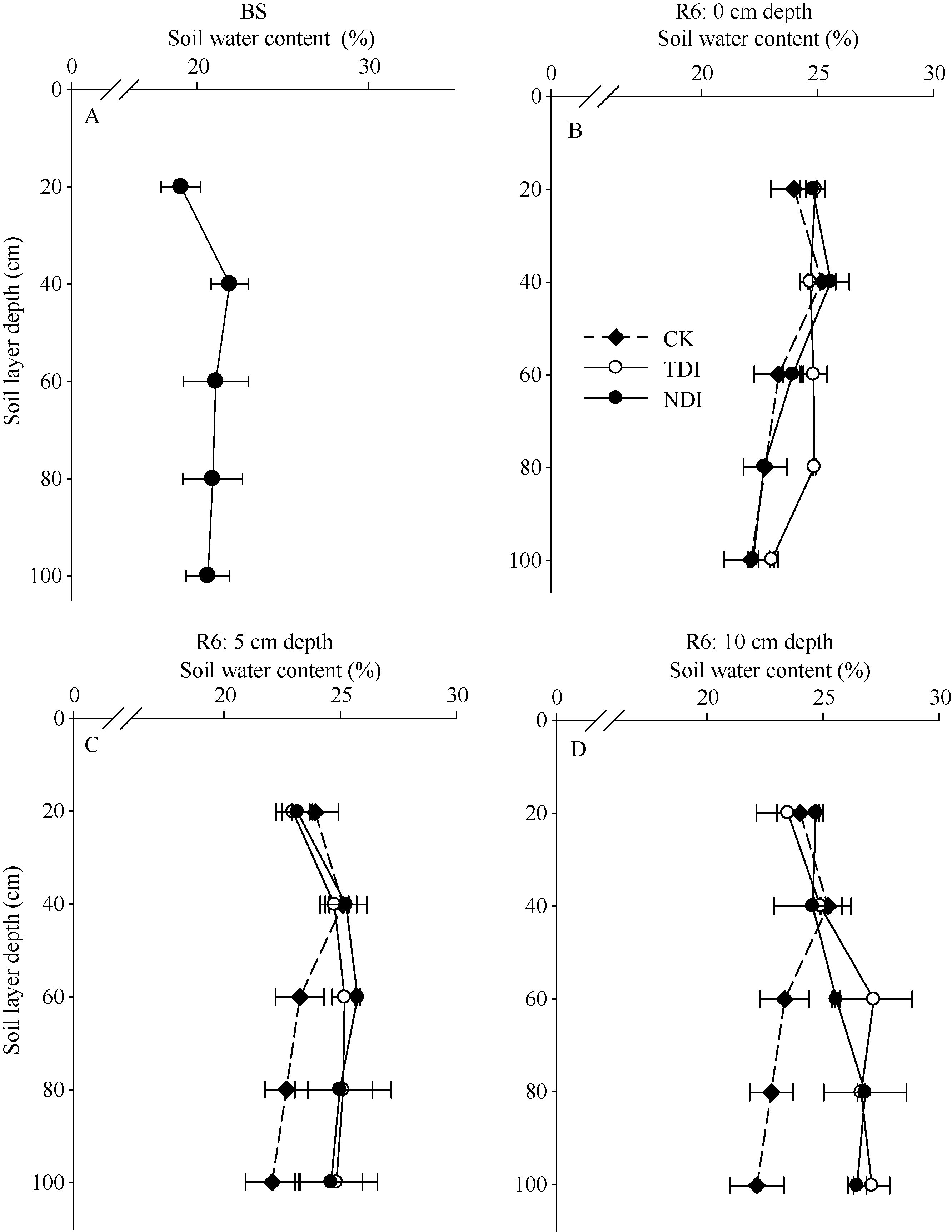
图4 不同滴灌方式播前和成熟期0~100 cm土层水分变化 处理同图2。 A、B、C和D分别表示各处理播前土壤含水量均值及埋深0 cm、5 cm和10 cm收获期土壤水分。BS: 0~100 cm土层播前土壤含水量; R6: 0~100 cm土层收获期土壤含水量。Fig. 4 Changes of soil water content in 0-100 cm soil layer before sowing and at mature stage under different drip irrigation treatments Treatments are the same as those given in Figure 2. A, B, C, and D represent the average soil water content before sowing, and soil water content at the depth of 0, 5, and 10 cm respectively. BS: soil water content in 0-100 cm soil layer before sowing; R6: soil water content in 0-100 cm soil layer after harvest.
表5 春玉米耗水量及水分利用效率 Table 5 Water consumption and water use efficiency under different drip irrigation systems
处理 Treatment
埋深 Dripline depth (cm)
耗水量 Water consumption (mm)
水分利用效率 Water use efficiency (kg m-3)
对照CK
441 c
2.11 b
传统滴灌Traditional drip irrigation (TDI)
0
481 a
2.28 a
5
479 a
2.14 b
10
461 b
2.20 b
对照CK
441 c
2.11 b
新型滴灌 New drip irrigation (NDI)
0
490 a
2.18 b
5
476 b
2.34 a
10
465 b
2.31 a
方差分析 ANOVA
滴灌管 Drip line (D)
ns
*
埋深 Dripline depth (DD)
*
*
滴灌管× 埋深 D× DD
ns
*
Values within a column followed by different letters are significantly different at the 0.05 probability level; ns: not significant; * Significant at the 0.05 probability level. 同一列内不同小写字母表示达到0.05显著水平; ns: 差异不显著; * 表示在0.05水平下显著。
表5 春玉米耗水量及水分利用效率 Table 5 Water consumption and water use efficiency under different drip irrigation systems
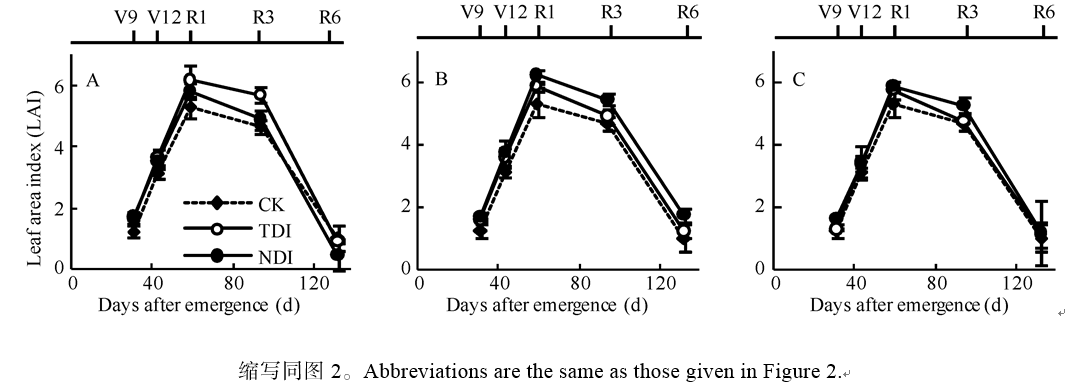
不同滴灌管类型对作物生长发育及产量的影响鲜见报道, 本研究发现不同类型滴灌管显著影响出苗率, 2种滴灌管中以新型滴灌埋深5 cm处理产量最高, 较地表滴灌增产显著。这是因为新型滴灌出水速度高于传统滴灌, 且出水量大, 其湿润锋上移速度快[18], 从而导致新型滴灌在合适埋深(5 cm)时出苗率较高。玉米出苗到拔节期间, 植株生长中心是根系, 为使根系发育良好, 并向纵深伸展, 需保持表土疏松干燥和下层土比较湿润的状况[27]。NDI-5和NDI-10处理能够满足幼苗期玉米生长的水分需要, 通过控制土壤水分在垂直剖面上的分布, 有利于根系在中后期充分利用深层次土层的水分与养分[28]。NDI-5吐丝后叶片衰老慢, 绿叶持续期长, 成熟期生物量高, 最终提高产量。 The authors have declared that no competing interests exist.
ChenC, LeiC, DengA, QianC, HoogmoedW, ZhangW. Will higher minimum temperatures increase corn production in Northeast China? An analysis of historical data over 1965-2008. Agric For Meteorol, 2011, 151: 1580-1588[本文引用:1]
[2]
马树庆, 王琪, 于海, 徐丽萍, 张铁林. 春旱对春玉米产量的影响试验研究. 自然灾害学报, 2012, 21: 207-212Ma SQ, WangQ, YuH, Xu LP, Zhang TL. Field experiment study into influence of spring drought on maize yield. J Nat Disasters, 2012, 21: 207-212 (in Chinese with English abstract)[本文引用:1][CJCR: 1.081]
[3]
王琪, 马树庆, 徐丽萍, 于海, 张铁林. 东北地区春旱对春玉米幼苗长势的影响指标和模式. 自然灾害学报, 2011, 20: 141-147WangQ, Ma SQ, Xu LP, YuH, Zhang TL. Indices and modes of spring drought influence on maize seedling growth in Northeast China. J Nat Disasters, 2011, 20: 141-147 (in Chinese with English abstract)[本文引用:2][CJCR: 1.081]
[4]
贺伟, 布仁仓, 熊在平, 胡远满. 1961-2005年东北地区气温和降水变化趋势. 生态学报, 2013, 33: 519-531HeW, Bu RC, Xiong ZP, Hu YM. Characteristics of temperature and precipitation in northeastern China from 1961 to 2005. Acta Ecol Sin, 2013, 33: 519-531 (in Chinese with English abstract)[本文引用:1]
[5]
MengK, ZhangX, SuiY, ZhaoJ. Analysis of water characteristics of black soil over long-term experimental researches in Northeast China. Bulg J Plant Physiol, 2004, 30(3/4): 111-120[本文引用:1]
[6]
宋振伟, 郭金瑞, 邓艾兴, 寇太记, 任军, 张卫建. 耕作方式对东北春玉米农田土壤水热特征的影响. 农业工程学报, 2012, 28(16): 108-114Song ZW, Guo JR, Deng AX, Kou TJ, RenJ, Zhang WJ. Effects of surface tillage regimes on soil moisture and temperature of spring corn farmland in Northeast China. Trans CSAE, 2012, 28(16): 108-114 (in Chinese with English abstract)[本文引用:1][CJCR: 2.121]
[7]
刘云发. 我国大田作物滴灌现状及发展前景. 节水灌溉, 1998, 4(4): 26-31Liu YF. Field crop irrigation status and development prospect in China. Water Saving Irrig, 1998, 4(4): 26-31 (in Chinese)[本文引用:1][CJCR: 0.644]
[8]
Wanjura DF, Upchurch DR, Mahan JR, Burke JJ. Cotton yield and applied water relationships under drip irrigation. Agric Water Manag, 2002, 55: 217-237[本文引用:1]
[9]
张晓伟, 黄占斌. 滴灌条件下玉米的产量和WUE效应研究. 水土保持研究, 1999, 6(1): 72-75Zhang XW, Huang ZB. Study on yield and WUE of corn under drip irrigation. Res Soil Water Conserv, 1999, 6(1): 72-75 (in Chinese with English abstract)[本文引用:1][CJCR: 1.173]
[10]
Camp CR, Sadler EJ, Busscher WJ. A comparison of uniformity measures for drip irrigation systems. Trans ASAE, 1997, 40: 1013-1020[本文引用:3]
[11]
Camp CR, Sadler EJ, Busscher WJ. Subsurface drip irrigation: a review. Trans ASAE, 1998, 41: 1353-1367[本文引用:2]
[12]
Phene CJ, Davis KR, Hutmacher RB, Mccormick RL. Advantages of subsurface irrigation for processing tomatoes. Acta Hortic, 1987, 200: 101-114[本文引用:1]
[13]
DouhB, BoujelbenA. Effects of surface and subsurface drip irrigation on agronomic parameters of maize (Zea mays L. ) under Tunisian climatic condition. J Nat Prod Plant Resour, 2011, 1(3): 8-14[本文引用:1]
[14]
PatelN, Rajput T B S. Effect of drip tape placement depth and irrigation level on yield of potato. Agric Water Manag, 2007, 88: 209-223[本文引用:2]
[15]
Schwankl LJ, Grattan SR, Miyao EM. Drip Irrigation Burial Depth and Seed Planting Depth Effects on Tomato Germination. In: Proc. Third International Irrigation Symp. Phoenix Arizona. ASAE, St. Joseph, Michigan, 1990. pp 682-687[本文引用:1]
[16]
李久生, 杜珍华, 栗岩峰, 李蓓. 壤土特性空间变异对地下滴灌水氮分布及夏玉米生长的影响. 中国农业科学, 2008, 41: 1717-1726Li JS, Du ZH, Li YF, LiB. Water and nitrogen distribution and summer maize growth in subsurface drip irrigation system as affected by spatial variations of soil properties. Sci Agric Sin, 2008, 41: 1717-1726 (in Chinese with English abstract)[本文引用:1][CJCR: 1.4]
[17]
RavinaI, PazE, SoferZ, MarcuA, ShishaA, SagiG. Control of emitter clogging in drip irrigation with reclaimed wastewater. Irrig Sci, 1992, 13: 129-139[本文引用:1][JCR: 2.843]
[18]
胡笑涛, 康绍忠, 王晓燕, 李志军. 地下滴灌灌水器的筛选试验研究. 沈阳农业大学学报, 2004, 35: 483-485Hu XT, Kang SZ, Wang XY, Li ZJ. Experiment on choosing emitter of subsurface drip irrigation. J Shenyang Agric Univ, 2004, 35: 483-485 (in Chinese with English abstract)[本文引用:2][CJCR: 0.556]
Allen RG, Pereira LS, RaseD, SmithM. Crop Evapotranspiration—Guidelines for Computing Crop Water Requirements—FAO Irrigation and Drainage Paper 56. RomeItaly: Food and Agriculture Organization of the United Nations, 1998[本文引用:1]
[21]
Yu XS, Liao YC, Olaposi IO. Effect of salinity water irrigation on maize growth in northwest region. J Chem Pharm Res, 2014, 6: 300-305[本文引用:1]
[22]
Liu XB, JinJ, Wang GH, Herbert SJ. Soybean yield physiology and development of high-yielding practices in Northeast China. Field Crops Res, 2008, 105: 157-171[本文引用:1][JCR: 2.608]
[23]
宋振伟, 郭金瑞, 任军, 闫孝贡, 郑成岩, 邓艾兴, 张卫建. 耕作方式对东北雨养区玉米光合与叶绿素荧光特性的影响. 应用生态学报, 2013, 24: 1900-1906Song ZW, Guo JR, RenJ, Yan XG, Deng AX, Zhang WJ. Effects of tillage patterns on photosynthetic and chlorophyll fluorescence characteristics of maize in rainfed area of Northeast China. Chin J Appl Ecol, 2013, 24: 1900-1906 (in Chinese with English abstract)[本文引用:1][CJCR: 1.904]
[24]
徐翠莲, 王冀川, 高山, 徐雅丽. 土壤水分调控对滴灌春小麦产量及分利用的影响. 华北农学报, 2013, 28(3): 127-132Xu CL, Wang JC, GaoS, Xu LN. Impacts of soil water controlling on grain yield and water use efficiency of spring wheat under drip irrigation. Acta Agric Boreali-Sin, 2013, 28(3): 127-132 (in Chinese with English abstract)[本文引用:1][CJCR: 1.289]
[25]
任杰, 温新明, 王振华, 安俊波. 地下滴灌毛管适宜埋深及间距研究进展. 水资源与水工程学报, 2007, 18(6): 48-51RenJ, Wen XM, Wang ZH, An JB. Research progress on appropriate depth and interval of lateral pipes in subsurface drip irriagation. J Water Resour Water Eng, 2007, 18(6): 48-51 (in Chinese with English abstract)[本文引用:1][CJCR: 0.418]
[26]
Lamm FR, Trooien TP. Dripline depth effects on corn production when crop establishment is nonlimiting. Appl Eng Agric, 2005, 21(5): 835[本文引用:1][JCR: 0.491]
[27]
山东农学院. 作物栽培学(上册). 北京: 农业出版社, 1985. p 229Shand ong AgricultureCollege. Crop Cultivation Science (first volume). Beijing: Agriculture Press, 1985. p 229 (in Chinese)[本文引用:1]
[28]
何华, 康绍忠, 曹红霞. 灌溉施肥部位对玉米同化物分配和水分利用的影响. 西北植物学报, 2003, 23: 1458-1461HeH, Kang SZ, Cao HX. Effect of fertigation depth on dry matter partition and water use efficiency of corn. Acta Bot Boreali-Occident Sin, 2003, 23: 1458-1461 (in Chinese with English abstract)[本文引用:1][CJCR: 0.947]

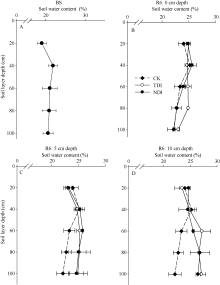
 表1 玉米生长季气象条件 Table 1 Weather data during maize growth season