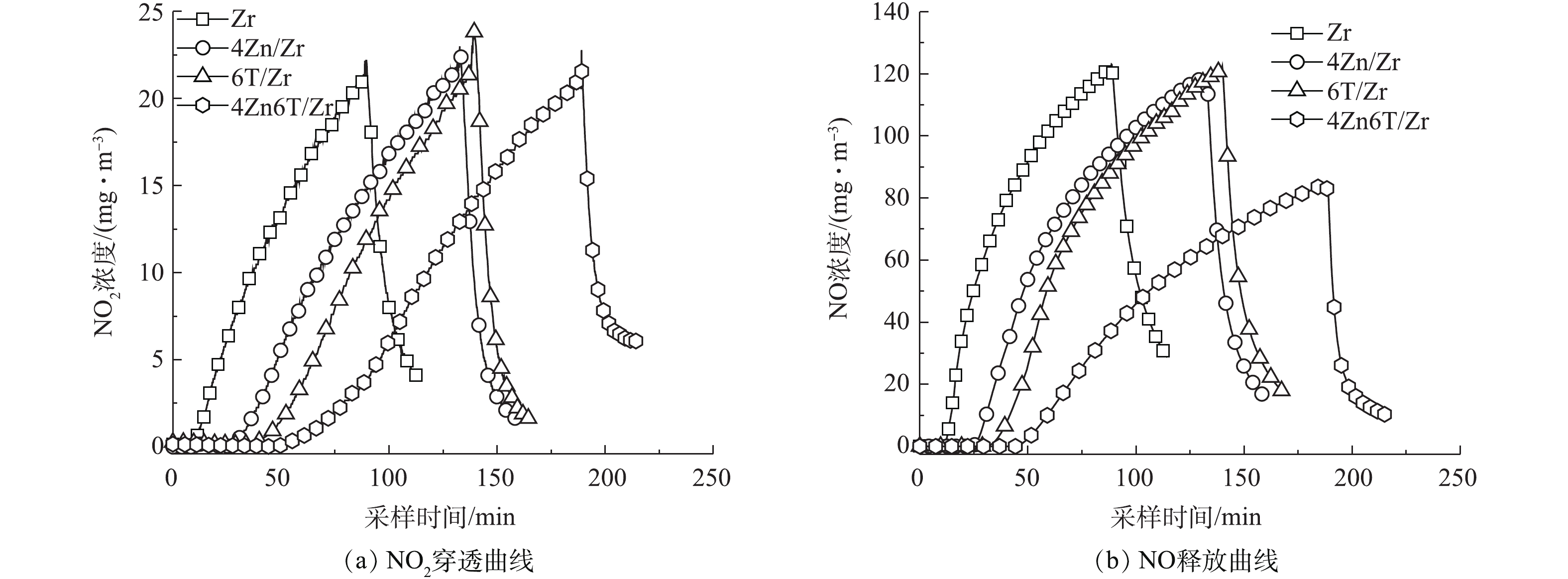
Abstract:By impregnating active components Zn, triethylenediamine (TEDA) and Zn-TEDA on the surface of zirconium hydroxide (Zr(OH)4) granules, the NO2 removal performance and mechanism of Zn and/or TEDA modified Zr(OH)4 were investigated. The interaction mechanisms of Zr(OH)4, Zn and TEDA with NO2 and yielded NO were discussed in detail. The results showed that the NO2 purifying ability of Zr(OH)4 was significantly improved by loading 4% Zn and 6% TEDA at the same time. The breakthrough time of the zinc-amine modified Zr(OH)4 could reach 84 min, the adsorption capacity for NO2 breakthrough could reach 24.8 mg·cm?3, and the NO release ratio decreased to 6%. In terms of the interaction mechanism with NO2 and NO, Zr(OH)4 matrix removed NO2 mainly through the reaction between surface terminal hydroxyls and NO2, and producing nitrate and nitrite. Zn mainly acted as the assistant of terminal hydroxyls, providing new surface basic adsorption sites for NO2 or acidic intermediates. TEDA could catalyze the surface hydrolysis of NO2 and led to NO2 transformation into more acidic HNO3 and HNO2, then NO2 can be removed quickly. When both Zn and TEDA were loaded, the matrix, metal and amine could cooperate effectively. The synergistic effect among them had a significant improvement on the NO2 removal performance of the material, NO release was delayed and its production proportion was significantly reduced. This provides guidance on the design and preparation of novel air purification materials for nitrogen oxides removal. Key words:zirconium hydroxide/ zinc/ triethylenediamine/ nitrogen oxides/ removal performance/ removal mechanism/ synergistic effect.
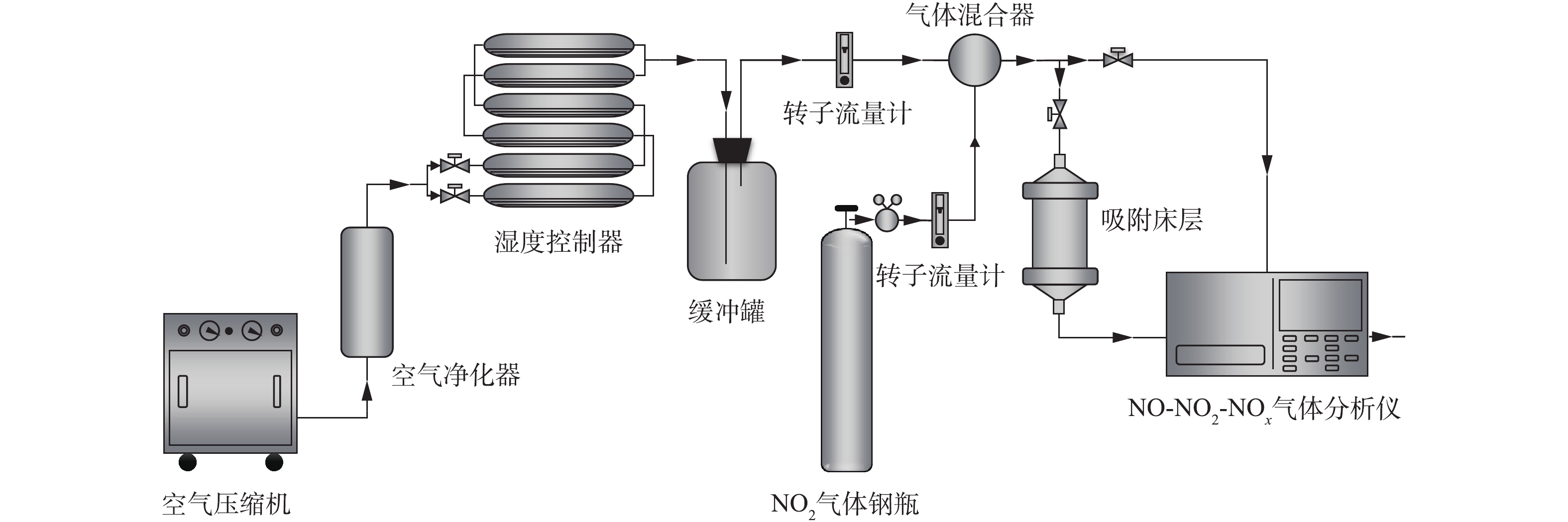
图1NO2脱除性能评价装置 Figure1.Evaluation devices for NO2 removal performance
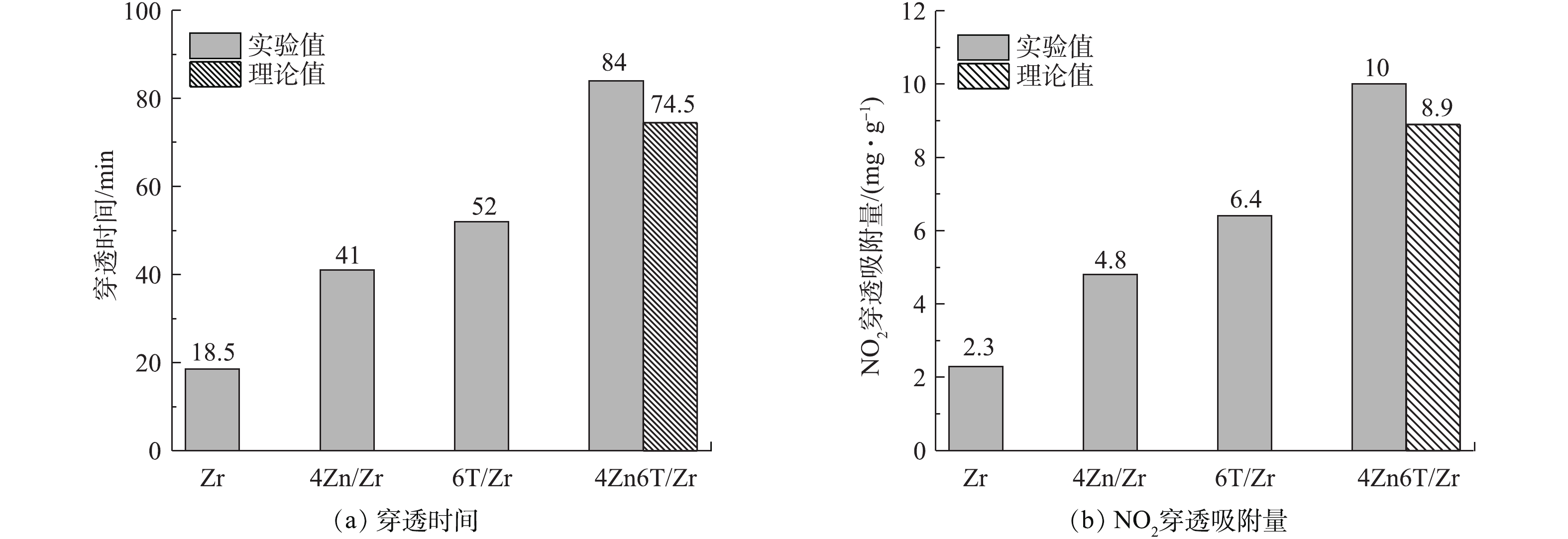
图3穿透时间和NO2穿透吸附量的实验值与理论计算值的比较 Figure3.Comparison of experimental values of breakthrough time and adsorption capacity of NO2 breakthrough with theoretical values
表1Zn和TEDA负载量对穿透时间的影响 Table1.Effects of Zn and TEDA loading amount on breakthrough time
单一负载金属Zn
单一负载有机胺TEDA
4% Zn +不同负载量TEDA
负载质量分数/%
穿透时间/min
负载质量分数/%
穿透时间/min
负载质量分数/%
穿透时间/min
0
18.5
0
18.5
0
41
1
22
2
30
2
53
2
26
4
38.5
4
68
3
33
6
52
6
84
4
41
8
74
8
75
5
36.5
10
90.5
10
66.5
单一负载金属Zn
单一负载有机胺TEDA
4% Zn +不同负载量TEDA
负载质量分数/%
穿透时间/min
负载质量分数/%
穿透时间/min
负载质量分数/%
穿透时间/min
0
18.5
0
18.5
0
41
1
22
2
30
2
53
2
26
4
38.5
4
68
3
33
6
52
6
84
4
41
8
74
8
75
5
36.5
10
90.5
10
66.5
下载: 导出CSV 表2不同材料的穿透时间、NO2穿透吸附量以及NO释放比例 Table2.Breakthrough time, adsorption capacity of NO2 breakthrough and NO release proportions of different materials
材料
穿透 物质
穿透时间/ min
单位质量 穿透 吸附量/ (mg·g?1)
单位体积 穿透 吸附量/ (mg·cm?3)
NO释放 比例/%
Zr
NO
18.5
2.3
5.5
13
4Zn/Zr
NO
41
4.8
12.1
11
6T/Zr
NO
52
6.4
15.3
10
4Zn6T/Zr
NO
84
10.0
24.8
6
材料
穿透 物质
穿透时间/ min
单位质量 穿透 吸附量/ (mg·g?1)
单位体积 穿透 吸附量/ (mg·cm?3)
NO释放 比例/%
Zr
NO
18.5
2.3
5.5
13
4Zn/Zr
NO
41
4.8
12.1
11
6T/Zr
NO
52
6.4
15.3
10
4Zn6T/Zr
NO
84
10.0
24.8
6
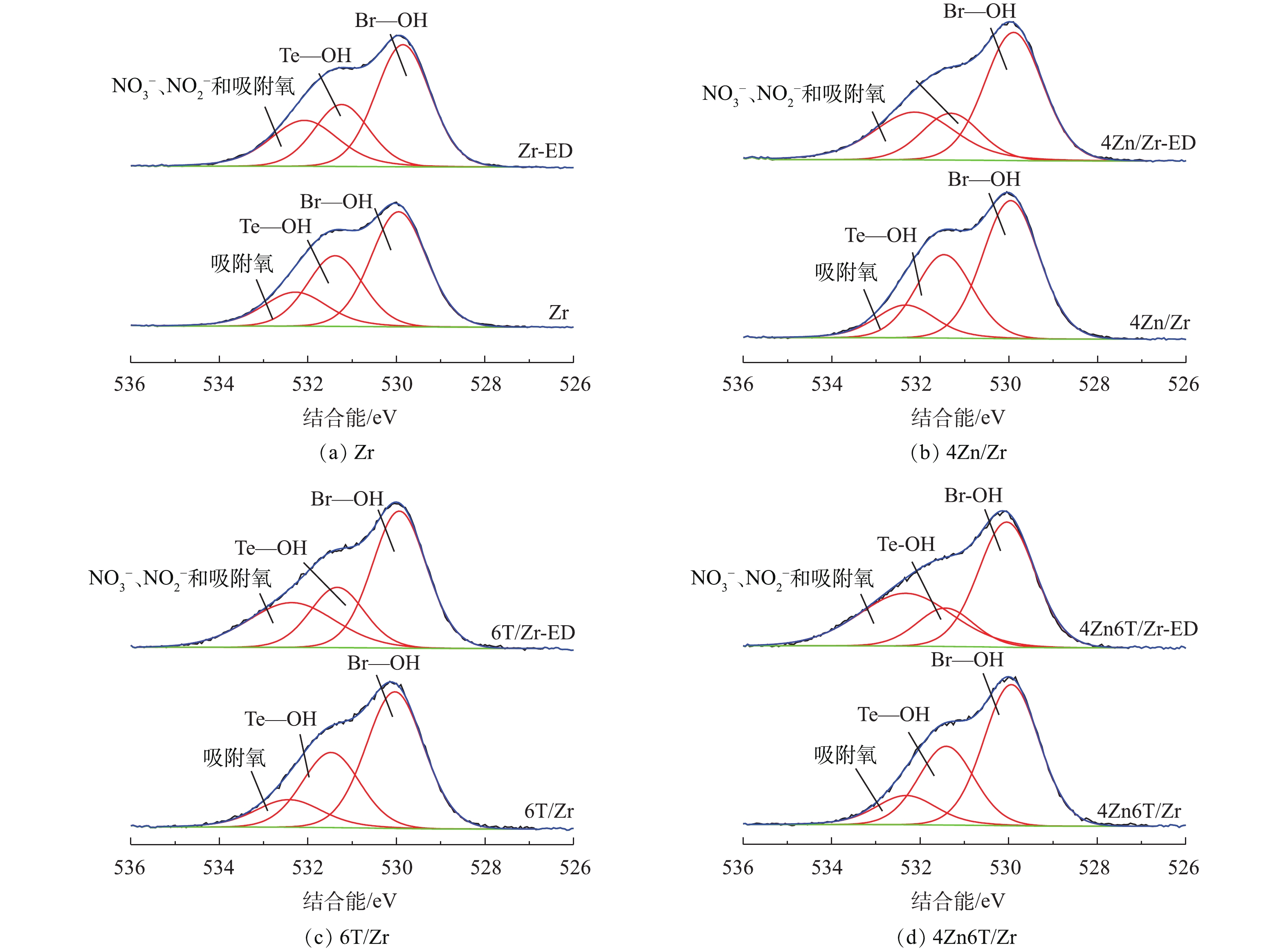
下载: 导出CSV 表3吸附NO2前后不同含氧官能团或表面物种含量的变化 Table3.Change in O-containing functional groups or surface species before and after NO2 adsorption
样品名称
含氧官能团或表面物种相对占比/%
Br—OH/Zr
Br—OH
Te—OH
吸附氧或吸附 氧+${\rm{NO}}_3^ - $ + ${\rm{NO}}_2^ - $
Zr
50.7
31.2
18.1
1.8
Zr-ED
51.0
24.2
24.8
1.8
4Zn/Zr
53.6
32.3
14.2
1.9
4Zn/Zr-ED
53.3
18.0
28.6
1.9
6T/Zr
55.7
30.6
13.7
1.8
6T/Zr-ED
55.9
15.4
28.7
1.9
4Zn6T/Zr
55.6
31.1
13.3
1.8
4Zn6T/Zr-ED
55.1
10.1
34.9
2.0
样品名称
含氧官能团或表面物种相对占比/%
Br—OH/Zr
Br—OH
Te—OH
吸附氧或吸附 氧+${\rm{NO}}_3^ - $ + ${\rm{NO}}_2^ - $
Zr
50.7
31.2
18.1
1.8
Zr-ED
51.0
24.2
24.8
1.8
4Zn/Zr
53.6
32.3
14.2
1.9
4Zn/Zr-ED
53.3
18.0
28.6
1.9
6T/Zr
55.7
30.6
13.7
1.8
6T/Zr-ED
55.9
15.4
28.7
1.9
4Zn6T/Zr
55.6
31.1
13.3
1.8
4Zn6T/Zr-ED
55.1
10.1
34.9
2.0
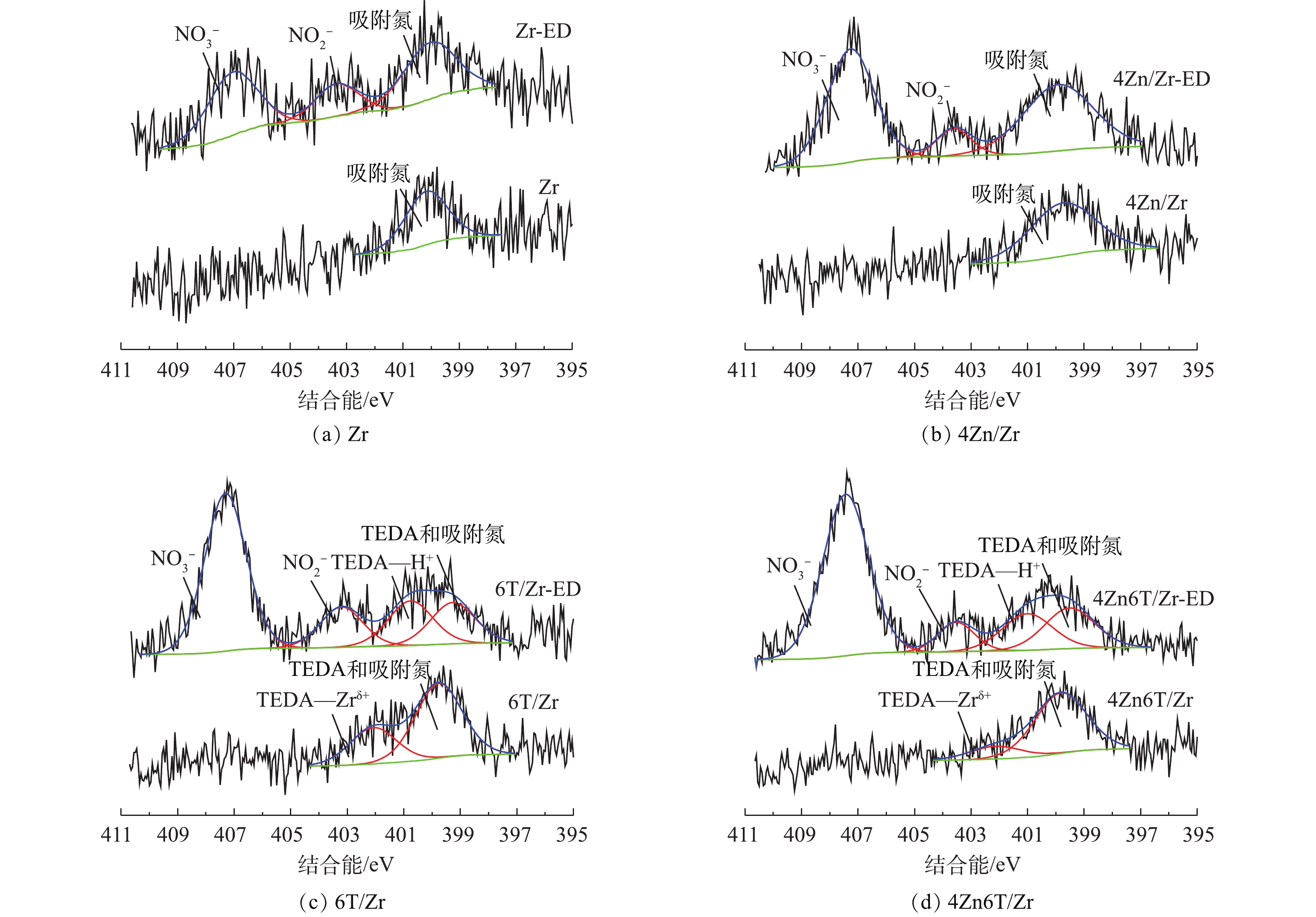
下载: 导出CSV 表4吸附NO2前后表面含氮物种的相对含量的变化 Table4.Change in N-containing species before and after NO2 adsorption
KARWACKI C J, JONES P. Toxic industrial chemical assessment report of NBC filter performance[R]. Maryland: The U.S. Army Edgewood Chemical Biological Center, 2000.
[2]
BOBBITT N S, MENDONCA M L, HOWARTH A J, et al. Metal-organic frameworks for the removal of toxic industrial chemicals and chemical warfare agents[J]. Chemical Society Reviews, 2017, 46(11): 3357-3385. doi: 10.1039/C7CS00108H
[3]
DECOSTE J B, PETERSON G W. Metal-organic frameworks for air purification of toxic chemicals[J]. Chemical Reviews, 2014, 114(11): 5695-5727. doi: 10.1021/cr4006473
[4]
MALEKI H. Recent advances in aerogels for environmental remediation applications: A review[J]. Chemical Engineering Journal, 2016, 300: 98-118. doi: 10.1016/j.cej.2016.04.098
NAWROCKI J, RIGNEY M, MCCORMICK A, et al. Chemistry of zirconia and its use in chromatography[J]. Journal of Chromatography A, 1993, 657(2): 229-282. doi: 10.1016/0021-9673(93)80284-F
[8]
HERTL W. Surface chemistry of zirconia polymorphs[J]. Langmuir, 1989, 5(1): 96-100. doi: 10.1021/la00085a018
[9]
MOGILEVSKY G, KARWACKI C J, PETERSON G W, et al. Surface hydroxyl concentration on Zr(OH)4 quantified by 1H MAS NMR[J]. Chemical Physics Letters, 2011, 511(4): 384-388.
[10]
PETERSON G W, KARWACKI C J, FEAVER W B, et al. Zirconium hydroxide as a reactive substrate for the removal of sulfur dioxide[J]. Industrial & Engineering Chemistry Research, 2009, 48(4): 1694-1698.
[11]
PETERSON G W, WAGNER G W, KELLER J H, et al. Enhanced cyanogen chloride removal by the reactive zirconium hydroxide substrate[J]. Industrial & Engineering Chemistry Research, 2010, 49(22): 11182-11187.
[12]
PETERSON G W, ROSSIN J A. Removal of chlorine gases from streams of air using reactive zirconium hydroxide based filtration media[J]. Industrial & Engineering Chemistry Research, 2012, 51(6): 2675-2681.
[13]
GLOVER T G, PETERSON G W, DECOSTE J B, et al. Adsorption of ammonia by sulfuric acid treated zirconium hydroxide[J]. Langmuir, 2012, 28: 10478-10487. doi: 10.1021/la302118h
[14]
BILLINGSLEY B G, BREY L A, BUECHTER W, et al. Layered or mixed sorbent bed protective filtration device: 9908076[P]. 2018-03-06.
[15]
BALOW R B, LUNDIN J G, DANIELS G C, et al. Environmental effects on zirconium hydroxide nanoparticles and chemical warfare agent decomposition: Implications of atmospheric water and carbon dioxide[J]. ACS Applied Materials & Interfaces, 2017, 9(45): 39747-39757.
[16]
BRADSHAW H, BUTLER C, STEPHENSON H. Zirconium hydroxide: 7794687[P]. 2010-09-14.
[17]
FEAVER W B, ROSSIN J A. Material and process for the filtration of nitric acid and NO2 from streams of air: 7678182[P]. 2010-03-16.
[18]
GUO G Y, CHEN Y L, YING W J. Thermal, spectroscopic and X-ray diffraction analyses of zirconium hydroxides precipitated at low pH values[J]. Materials Chemistry & Physics, 2004, 84(2): 308-314.
[19]
LIU H, SUN X, YIN C, et al. Removal of phosphate by mesoporous ZrO2[J]. Journal of Hazardous Materials, 2008, 151(2/3): 616-622.
[20]
SENGUPTA A, MALIK S N, BAHADUR D. Developing superhydrophobic and oleophobic nanostructure by a facile chemical transformation of zirconium hydroxide surface[J]. Applied Surface Science, 2016, 363: 346-355. doi: 10.1016/j.apsusc.2015.12.047
[21]
GIANNAKOUDAKIS D A, MITCHELL J K, BANDOSZ T J. Reactive adsorption of mustard gas surrogate on zirconium (hydr)oxide/graphite oxide composites: The role of surface and chemical features[J]. Journal of Materials Chemistry A, 2016, 4(3): 1008-1019. doi: 10.1039/C5TA09234E
[22]
KIM S, BYL O, YATES J T. The adsorption of triethylenediamine on Al2O3-I: A vibrational spectroscopic and desorption kinetic study of surface bonding[J]. The Journal of Physical Chemistry B, 2005, 109(8): 3499-3506. doi: 10.1021/jp0405512
[23]
REZAEI F, JONES C W. Stability of supported amine adsorbents to SO2 and NOx in postcombustion CO2 capture. 1. Single-component adsorption[J]. Industrial & Engineering Chemistry Research, 2013, 52(34): 12192-12201.
[24]
BROSIUS R, BAZIN P, THIBAULT-STARZYK F, et al. Operando FTIR study of reaction pathways of selective catalytic reduction of NOx with decane in the presence of water on iron-exchanged MFI-type zeolite[J]. Journal of Catalysis, 2005, 234(1): 191-198. doi: 10.1016/j.jcat.2005.06.010
[25]
HADJIIVANOV K I. Identification of neutral and charged NxOy surface species by IR spectroscopy[J]. Catalysis Reviews, 2000, 42(1/2): 71-144.
[26]
PETERSON G W, ROSSIN J A, KARWACKI C J, et al. Surface chemistry and morphology of zirconia polymorphs and the influence on sulfur dioxide removal[J]. The Journal of Physical Chemistry C, 2011, 115(19): 9644-9650. doi: 10.1021/jp201173x
[27]
U.S. National Institute of Standards and Technology. The NIST X-ray photoelectron spectroscopy database[EB/OL]. [2019-07-11]. https://srdata.nist.gov/xps/Default.aspx, 2012.
[28]
LIU E, SARKAR B, CHEN Z, et al. Decontamination of chlorine gas by organic amine modified copper-exchanged zeolite[J]. Microporous and Mesoporous Materials, 2016, 225: 450-455. doi: 10.1016/j.micromeso.2016.01.023
[29]
BALTRUSAITIS J, JAYAWEERA P M, GRASSIAN V H. XPS study of nitrogen dioxide adsorption on metal oxide particle surfaces under different environmental conditions[J]. Physical Chemistry Chemical Physics, 2009, 11(37): 8295-8305. doi: 10.1039/b907584d
State Key Laboratory of NBC Protection for Civilian, Research Institute of Chemical Defense, Beijing 100191, China Received Date: 2019-11-06 Accepted Date: 2020-01-23 Available Online: 2020-10-14 Keywords:zirconium hydroxide/ zinc/ triethylenediamine/ nitrogen oxides/ removal performance/ removal mechanism/ synergistic effect Abstract:By impregnating active components Zn, triethylenediamine (TEDA) and Zn-TEDA on the surface of zirconium hydroxide (Zr(OH)4) granules, the NO2 removal performance and mechanism of Zn and/or TEDA modified Zr(OH)4 were investigated. The interaction mechanisms of Zr(OH)4, Zn and TEDA with NO2 and yielded NO were discussed in detail. The results showed that the NO2 purifying ability of Zr(OH)4 was significantly improved by loading 4% Zn and 6% TEDA at the same time. The breakthrough time of the zinc-amine modified Zr(OH)4 could reach 84 min, the adsorption capacity for NO2 breakthrough could reach 24.8 mg·cm?3, and the NO release ratio decreased to 6%. In terms of the interaction mechanism with NO2 and NO, Zr(OH)4 matrix removed NO2 mainly through the reaction between surface terminal hydroxyls and NO2, and producing nitrate and nitrite. Zn mainly acted as the assistant of terminal hydroxyls, providing new surface basic adsorption sites for NO2 or acidic intermediates. TEDA could catalyze the surface hydrolysis of NO2 and led to NO2 transformation into more acidic HNO3 and HNO2, then NO2 can be removed quickly. When both Zn and TEDA were loaded, the matrix, metal and amine could cooperate effectively. The synergistic effect among them had a significant improvement on the NO2 removal performance of the material, NO release was delayed and its production proportion was significantly reduced. This provides guidance on the design and preparation of novel air purification materials for nitrogen oxides removal.

 下载:
下载: 


 点击查看大图